Zoho People is a good fit if you want low-cost, configurable HR software and can invest time in setup. It covers employee records, time off, attendance, onboarding, performance, and learning in one system. It works best for companies that already use other Zoho apps.
The trade-offs are setup effort and plan structure. In the US, attendance and performance tools sit in two separate plans, so many teams end up on Enterprise. Payroll is a separate product.
In this Zoho People review, I cover 2026 pricing for US and international buyers and the new Zia AI assistant. I also cover user ratings and the limits worth knowing before you sign up.
Zoho People review: Quick verdict
Zoho People offers broad HR coverage at a low per-user price, with setup effort as the main time cost.
Category
Zoho People at a glance
Best for
Small and midsize teams that want configurable HR software at a low per-user cost
Free plan
Yes, for 3 users in the US and 5 users elsewhere
Paid plans
From $3 per user per month in the US, billed annually
Free trial
30 days on paid plans
Core features
Employee records, time off, attendance, onboarding, performance, OKRs, LMS, HR help desk
AI features
Zia AI HR assistant for questions, HR actions, and insights
Payroll
Not included; Zoho Payroll is a separate product
Main strength
Flexible workflows and native Zoho integrations
Main drawback
Setup effort and a US plan structure that splits key modules
Verdict
A cost-effective pick for teams that want control. Less suited to teams that want a quick setup or built-in payroll.
What is Zoho People?
Zoho People is cloud-based HR software from Zoho Corporation, the company behind Zoho CRM and Zoho Books. Some buyers search for it as Zoho HR or Zoho HRMS. It handles core HR, time off, attendance, onboarding, performance, and training in one platform.
The product is modular. Admins turn on the services they need, then configure forms, fields, approvals, and workflows for each one. Advanced admins can write custom functions in Deluge, Zoho’s scripting language.
Zoho People is also part of Zoho One, Zoho’s full app bundle. If your company already pays for Zoho One, you can use Zoho People without a separate subscription.
Zoho People pros and cons
Zoho People gives you broad HR coverage at a low price, but setup takes planning, and the plan structure can push costs up.
Pros
Cons
Low per-user price for the module coverage
Setup has a learning curve, with many settings to configure
Attendance, OKRs, LMS and help desk in one system
US plans split attendance and performance across two tiers
Configurable forms, workflows and approvals
Custom reports take effort or need Zoho Analytics
Native links to Zoho Recruit, Books, Analytics, and other Zoho apps
Payroll is a separate product with its own cost
Zia AI assistant included from Essential HR in the US
Some reviewers find navigation dated or crowded
Free plan and a 30-day trial on paid plans
Premium support costs extra below Enterprise
Zoho People pricing in 2026
US-based pricing
Zoho People pricing depends on where you buy: US visitors see one plan lineup, and most other countries see another.
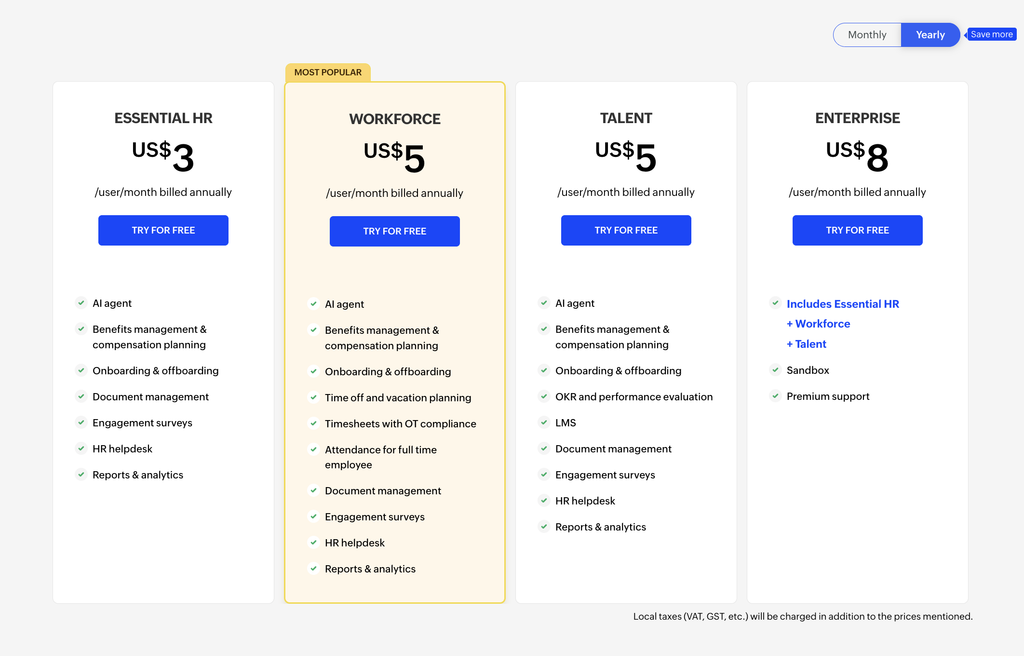
US visitors see Essential HR, Workforce, Talent, and Enterprise.
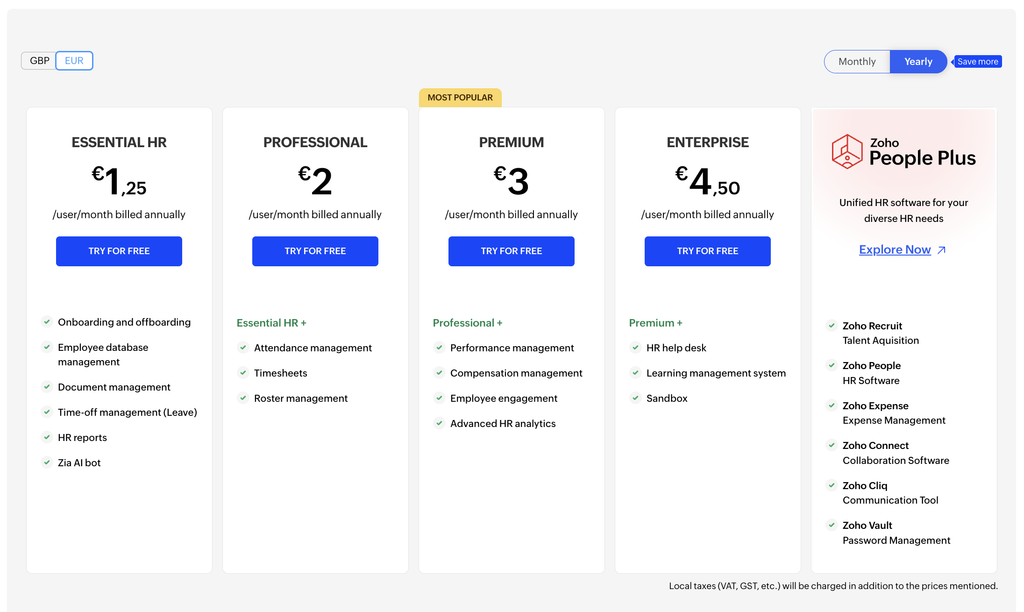
Visitors from most other countries see Essential HR, Professional, Premium, and Enterprise. Both lineups include a free plan.
US pricing plans compared
US plans range from a free tier for 3 users to Enterprise at $8 per user per month with annual billing.
Plan
Annual billing
Monthly billing
What it adds
Free
$0
$0
Employee database, basic time off, documents, up to 3 users
Essential HR
$3
$4
Zia AI agent, onboarding and offboarding, benefits and compensation planning, engagement surveys, HR help desk, reports
Workforce
$5
$6
Essential HR plus time off and vacation planning, attendance, timesheets with overtime compliance
Talent
$5
$6
Essential HR plus OKRs, performance evaluation and LMS
Enterprise
$8
$10
Essential HR, Workforce and Talent combined, plus sandbox and premium support
Prices are per user per month, before tax. Zoho’s pricing page lists a 5-user minimum for paid plans. Organizations with more than 500 users get a custom quote.
Which US plan do you need?
Choose your plan by the modules you need, because Workforce and Talent are parallel plans built on the same base.
Records, onboarding, and documents: Essential HR.
Time off, attendance, and timesheets: Workforce.
Performance reviews, OKRs and training: Talent.
Attendance tracking and performance reviews together: Enterprise.
This is the main cost factor in US pricing. A team that needs attendance tracking and performance reviews cannot get both on a $5 plan.
International pricing differences
European pricing
Outside the US, Zoho People uses a ladder where each plan adds modules to the one below it.
Plan
Annual billing
Main additions
Free
$0
Employee database, time off, documents, up to 5 users
Essential HR
$1.25
Onboarding, offboarding, leave, HR reports, Zia
Professional
$2
Attendance, timesheets, shift and roster management
Currency and taxes vary by country. Visitors from India, for example, see prices in rupees.
How much does Zoho People really cost?
For US teams of 10 to 50 people, annual license fees range from a few hundred dollars to just under $5,000.
Employees
Essential HR
Workforce or Talent
Enterprise
10
$360
$600
$960
25
$900
$1,500
$2,400
50
$1,800
$3,000
$4,800
These figures cover licenses only, billed annually. Budget for these extras too:
Payroll: Zoho Payroll Standard for the US costs $29 per month plus $5 per employee, billed annually. It covers one state. Multi-state payroll requires Professional at $49 per month plus $7 per employee. A 25-person team on Workforce plus Payroll Standard pays about $3,350 a year.
Premium support: it is included in Enterprise and sold as a paid add-on on other plans.
Implementation help: Zoho sells Jumpstart onboarding packages, from 25 hours on Essential HR to 80 hours on Enterprise.
Zia AI usage: Zia runs on AI tokens. Paid plans include free starter credits, so heavy AI use may cost more over time.
Monthly billing: it adds $1 to $2 per user per month compared with annual billing.
One cost works in your favor. Zoho charges licenses only for active users, so you can reassign seats when people leave.
Zoho People vs Zoho People Plus
Zoho People Plus bundles Zoho People with Zoho Recruit and other Zoho apps at a higher per-user price.
In the US, People Plus Premium costs $8 per user per month with annual billing. It includes Zoho Recruit Standard, Zoho People at Workforce level, and Zoho Cliq. People Plus Enterprise costs $12 and adds Zoho People Enterprise, Expense, Connect, and Vault. Zoho raised both prices in mid-2026, so some review sites still list the older $4 and $9.
Note the overlap. People Plus Premium costs the same as Zoho People Enterprise but leaves out performance and learning. Outside the US, bundle contents vary, and some regions include Zoho Payroll.
Choose People Plus if you also need recruiting and expense tools. If you only need HR, standalone Zoho People costs less.
Zoho People features: What do you actually get?
This content is hosted by a third party. Accept marketing cookies to view it.
Zoho People covers the full employee lifecycle, and its 2026 updates focus on AI, OKRs, and offer letters. Below are the modules buyers compare most.
Core HR and employee records
The employee database is the base of every plan, including Free. You store profiles, job details, documents, and custom fields in one place. Admins build custom forms and set role-based permissions for each field. Employees update their own details through self-service, which cuts routine requests to HR.
Leave and attendance tracking are among the features G2 reviewers mention most often as strengths. Admins set leave types, accrual rules, carryover, and holiday calendars. Attendance works through web, mobile, kiosk, facial recognition, and biometric devices. Geo-fencing and IP restrictions control where people can check in.
Shift scheduling, overtime rules, and timesheets connect hours to projects and clients. In September 2026, Zoho added auto check-out for employees who forget to clock out. A shift can close at a fixed time, after a set duration, or at the end of the shift.
In the US, attendance and timesheets require Workforce or Enterprise.
Read more: For leave-only needs, our roundup of PTO tracking software covers lighter tools.
Onboarding, offboarding, and offer letters
Onboarding is included in Essential HR, and 2026 added a full offer letter module. New hires fill in forms and upload documents through a candidate portal before day one. Checklists cover IT setup, asset allocation, and policy sign-off. Since October 2026, HR can flag specific fields for correction, with an audit trail of each change.
The offer letter module launched in April 2026. It creates offer and appointment letters from templates, supports e-signature, and tracks responses. Later updates added approval steps and the option to withdraw and reissue letters.
Zia can also run onboarding actions, such as starting onboarding or reopening the candidate portal.
Performance tools include appraisals, 360-degree feedback and goals, and OKRs, which arrived as a new service in May 2026. You can run self-appraisals, multi-rater reviews, skill matrices, and 9-box assessments. The OKR service lets teams set objectives, align them across levels, and track key results with check-ins. Since August, milestones can serve as a progress type for key results.
Reviews can now include attendance and leave data. That gives managers more context, so agree in advance on how absence data affects ratings.
In the US, performance tools and OKRs require Talent or Enterprise.
Zia is the AI assistant built into Zoho People, and Zoho rebuilt it in Q2 2026 so it can also run HR tasks. Zoho announced the new Zia in June 2026. Here is what it handles in practice:
HR questions: employees ask about leave balances or policies in plain language, by chat or voice.
Document search: since July 2026, employees can find and download files shared with them through prompts.
Routine actions: Zia can apply for leave, check people in, send reminders, and run onboarding steps.
Workforce insights: HR can ask for reports, charts, and trend summaries, such as attrition by region.
Zia also works in Microsoft Teams, Slack, and the Zoho People mobile app. Check three limits before you plan around it:
Zia is enabled only for administrator roles by default, so you need to extend access to employees.
Zoho notes that Zia may not be available in every region.
When Zia is on, Zoho may process your data through its own hosted language models. Zoho states that sensitive and health data is not shared.
Zia usage is measured in AI tokens. According to Zoho’s Zia documentation, all paid plans include free token credits to get started. Zoho does not publish a token allowance per plan for Zoho People. If you plan frequent AI reports or actions, ask Zoho about limits and extra costs before you buy. Admins can also connect their own OpenAI key instead.
Rule-based automation sits next to Zia. HR events can trigger email alerts, field updates, checklists, and custom functions. 2026 updates added offboarding triggers and custom actions when an HR process starts.
Read more: For a broader view of what to automate first, see our guide to HR workflow automation.
Learning management system
Zoho People’s LMS lets you build internal courses, and since July 2026, AI can draft assessment questions.
Courses can mix files, videos, quizzes, and live sessions. You can run self-paced or blended learning and collect course feedback. The AI tool writes questions from a topic or an uploaded file, and you set the count, type, difficulty, and marks. The LMS has also been SCORM-compatible since May 2025, so you can import standard course packages.
In the US, the LMS requires Talent or Enterprise.
Employee engagement and HR help desk
In the US, engagement surveys and the HR help desk are both part of Essential HR. Surveys collect employee feedback on a schedule you set. The help desk handles employee requests as cases, with assignment rules and SLA tracking. It suits policy questions, document requests, and payroll queries.
Outside the US, the help desk is part of the Enterprise plan.
Reports and analytics
Standard reports cover headcount, leave, attendance, and timesheets, while deeper analysis needs Zoho Analytics. Built-in reports handle routine summaries. For trend dashboards, Zoho People connects to Zoho Analytics, which supports plain-language questions through Ask Zia.
Reviewers on Capterra and G2 often say custom reports take extra effort. If reporting is a priority, test it during the trial with your own data.
Read more: Our list of HR analytics software covers tools built for reporting first.
Zoho People mobile app
The Zoho People app covers daily employee tasks on iOS and Android. Employees can check in and out, apply for leave, view balances, and use Zia from their phones. Admin setup happens in the web app. Some reviewers report lag or missing features compared with the web version.
Zoho People integrations and payroll
Zoho People connects natively with most Zoho apps and a set of third-party tools, but payroll requires a separate product.
Collaboration: Slack, Microsoft Teams and WhatsApp.
Workspace tools: Google Workspace and Microsoft services for user import and calendar sync.
Other tools: QuickBooks, DocuSign, Adobe Sign and Zapier.
Payroll partners: Xero in the UK and Australia, plus greytHR and Paybooks in India.
For custom connections, Zoho People offers an API. Daily API limits rise with plan, from 5,000 calls on Essential HR to 25,000 on Enterprise.
Zoho People does not run payroll itself. In the US, Zoho Payroll is a separate subscription that covers all 50 states. Zoho’s US launch materials list data sync with Zoho People.
Zoho People user reviews and ratings
Zoho People rates well across major review sites, and reviewers praise daily ease of use more than you might expect from a configurable tool.
Capterra and GetApp are both Gartner sites and share much of the same review pool, so treat them as one signal.
What users like:
Daily use is simple. Ease of use is the most-tagged pro on G2.
Attendance and leave tracking come up often as strengths.
Value for money stands out for small and midsize teams.
Teams already on Zoho value the native integrations.
What users dislike:
Initial setup takes time and has a learning curve.
Customization gets mixed feedback. Some reviewers praise flexible workflows, while limited customization is the most-tagged con on G2.
Custom reporting takes extra effort.
Support responsiveness varies, especially for technical issues.
Some advanced features sit in higher plans.
These are patterns across reviews, not every buyer’s experience.
Where Zoho People falls short
Beyond the plan split and separate payroll covered above, the main gaps are setup effort, reporting depth, and regional differences.
Setup takes planning. The admin panel has many services and settings. Without a clear map of your HR processes, configuration turns into trial and error. Zoho sells paid onboarding help, which shows how often buyers need support here.
Reporting needs extra tools. Built-in reports cover the basics. Complex reports often mean Zoho Analytics or spreadsheet exports.
Regional differences affect global teams. Plans, prices, Zia availability, and payroll options change by country. Confirm what applies to each entity before you buy.
Who should use Zoho People?
Zoho People fits cost-conscious small and mid-size teams that want control over their HR workflows.
Good fit:
Companies already using Zoho CRM, Zoho Books, or Zoho One.
Teams with shifts, field staff, or detailed attendance rules.
HR teams with an admin who can own the configuration.
Organizations that want OKRs, LMS and a help desk in one system.
Less suited to:
Teams that want a working system with minimal setup.
US companies that want HR and payroll in one subscription.
Companies that need advanced custom reporting without extra tools.
Zoho People alternatives
If Zoho People feels too complex or misses a capability you need, these platforms cover different priorities.
BambooHR has a polished interface and a built-in ATS. Core starts at $10 per employee per month for teams with more than 25 employees, with flat pricing for smaller teams. Our list of BambooHR alternatives covers similar tools.
Rippling combines HR with IT and device management, which suits teams that provision apps and hardware from employee records.
Gusto focuses on US payroll, tax filing, and benefits for small businesses. For other payroll-first options, see our Gusto alternatives.
Deel handles global payroll, contractors, and employer-of-record services for international teams.
HiBob centers on people experience and culture tools for midsize, distributed companies.
Personio is HR software popular with European small and midsize businesses.
Thrivea offers free Core HR for small teams and paid add-on modules. The next section compares it with Zoho People.
Zoho People vs Thrivea
Zoho People offers a wider range of HR modules, while Thrivea gives small and growing teams a simpler, more affordable way to manage everyday HR tasks. With free Core HR for up to 30 employees and optional paid modules, Thrivea lets you start with the essentials and expand as your needs change.
Here’s how the two compare:
Category
Zoho People
Thrivea
Free plan
3 users in the US, 5 elsewhere
Free Core HR for up to 30 employees
Pricing model
Tiered per-user plans
Modular pricing; pay for the features you need
Employee records and documents
Yes
Yes, included in Core HR
Time off
Yes, Workforce in the US
Dedicated Time Off module with PTO accrual and approvals
Attendance and timesheets
Yes
Not offered
Performance reviews
Yes, Talent in the US
Optional Performance & Growth module
LMS
Yes
Not offered
AI
Zia assistant for HR questions, actions, and insights
AI Governance tools for tracking and managing workplace AI use
Payroll
Separate Zoho Payroll subscription
Not offered
Integrations
Extensive Zoho ecosystem and third-party integrations
MCP connectivity for AI assistants
Setup
Extensive configuration options
Designed for non-technical HR teams
Where Thrivea stands out is its accessible starting point. Zoho People’s free plan is limited to a handful of users, while Thrivea gives teams of up to 30 employees free access to core HR features, including employee records and documents. You can add Time Off or Performance & Growth as separate modules without moving to a higher-priced bundle.
Thrivea also takes a different approach to AI. While Zoho’s Zia assistant helps employees complete HR tasks, Thrivea’s AI Governance tools help organizations understand and manage how AI is used across the workplace.
Zoho People remains a stronger option for companies that need shift scheduling, attendance tracking, an LMS, or extensive Zoho integrations.
For smaller teams focused on organizing employee information, automating HR workflows, and managing time off without unnecessary complexity, Thrivea offers a more practical starting point.
Is Zoho People worth it in 2026?
Yes, if you value low cost and flexibility and have someone to handle setup. The 2026 updates make the product stronger. Zia now runs HR tasks, OKRs are built in, and offer letters no longer need a separate tool.
Already on Zoho: Zoho People is the natural choice.
Need attendance and performance in the US: budget for Enterprise from the start.
Want simple setup or bundled payroll: shortlist the alternatives above.
Use the 30-day trial with your real leave policies and one review cycle before you commit.
Is Zoho People worth it in 2026?
Yes, if you want low-cost, configurable HR software and have someone to own the setup. The 2026 updates make the product stronger. Zia now runs HR tasks, OKRs are built in, and offer letters no longer need a separate tool.
Your decision comes down to three points:
You already use Zoho apps: Zoho People is the natural choice.
You need attendance and performance reviews in the US: budget for Enterprise from the start.
You want simple setup or payroll in the same subscription: shortlist the alternatives above.
Whichever way you lean, run the 30-day trial with your real leave policies and one review cycle before you commit.
If you want a simpler starting point, try Thrivea. Core HR is free for up to 30 employees, and you can sign up without a credit card. Start with employee records, documents, and time off, then add modules as your team grows.
Zoho People FAQs
Is Zoho People worth it in 2026?
Yes, for small and midsize teams that want configurable HR software at a low price. It is less suited to teams that want minimal setup or payroll in the same subscription.
How much does Zoho People cost?
US plans run from free to $8 per user per month with annual billing. Most international plans run from free to $4.50. Payroll and premium support cost extra.
Is Zoho People free?
Yes. The free plan covers the employee database, basic time off, and documents for up to 3 users in the US and 5 users elsewhere.
Does Zoho People include payroll?
No. Payroll runs through Zoho Payroll, a separate product, or through partner integrations. Zoho Payroll covers all 50 US states.
What are the main disadvantages of Zoho People?
Setup takes time, custom reports need extra effort, and US plans split attendance and performance tools. Payroll and premium support add cost.
Does Zoho People have AI features?
Yes. Zia answers HR questions, finds documents, runs routine actions, and builds reports from plain-language prompts. The LMS also uses AI to draft assessment questions.
What is the difference between Zoho People and Zoho People Plus?
Zoho People is the HR platform on its own. Zoho People Plus bundles it with Zoho Recruit and other Zoho apps, such as Expense and Vault, at a higher price.
Is Zoho People better than BambooHR?
Zoho People costs less and offers attendance, OKRs, and an LMS. BambooHR has a more polished interface but costs more per employee. The better choice depends on budget and admin capacity.
Create your account and explore the full platform — no
credit card, no sales call.
Want a tailored walkthrough? Our team will show how
Thrivea fits your workflows and scales with you.
Deel review 2026: current pricing for Deel HR, EOR, contractors, payroll and PEO, plus real user feedback and key limitations. Find out who Deel suits...
Gusto handles US payroll, tax filing, benefits administration, and basic HR tasks in one platform. Its transparent pricing appeals to small businesses...






 Read more